
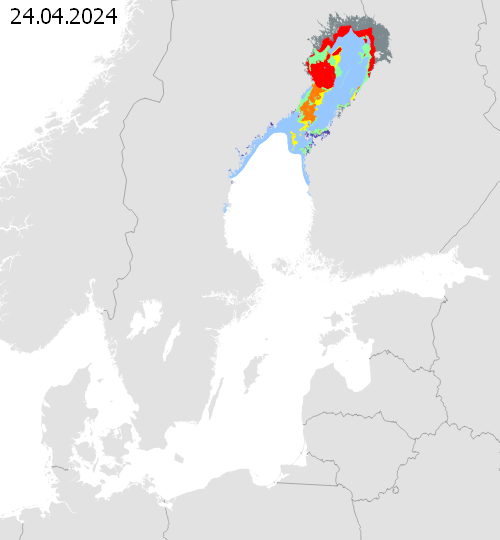
07.04.2026
In the Bay of Bothnia, there is up to 80 cm thick, locally rotten fast ice, along the coasts in the north. In the south is rotten fast ice at places. At sea in the north, there is very close, 20–50 cm thick and in places ridged and rafted ice. Leads and cracks occur in the ice field. Along the coasts of the Quark and the northern Bothnian Sea, there is rotten fast ice. In the Gulf of Finland, there is 5–20 cm thick, very close ice at sea in the northeast. In the northeastern Gulf of Riga, there is very close ice along the coast.
News and dates
- The ice winter of 2019/20 on the German coasts and the entire Baltic Sea region.
- Eiswinter 2019/20 an den deutschen Küsten und im gesamten Ostseeraum.
- Archive »
- Images »
Ice Information
BSIC
© 2020 Baltic Sea Ice Services - Marina Kirchhoff (BSH Rostock/Germany)
Bundesamt für Seeschifffahrt und Hydrographie (BSH)
Bundesamt für Seeschifffahrt und Hydrographie (BSH)